
We co-hosted an event with our social partner for fisheries and an MEP. We presented our legal proposals for a safer, healthier and more worker-friendly fisheries sector in Europe.
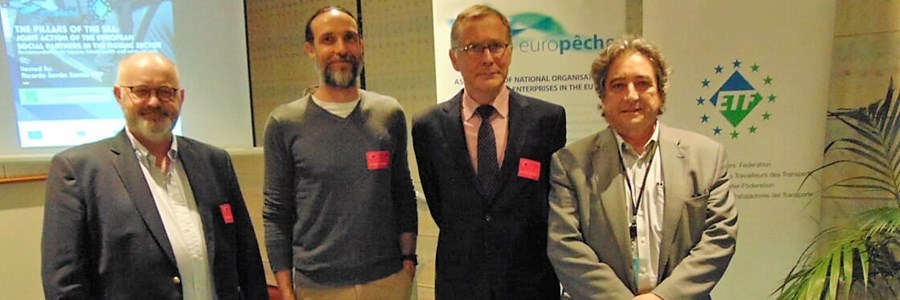
The European social partners for fisheries, Europêche and ETF, co-hosted a successful conference yesterday evening in the European Parliament with MEP Ricardo Serrão Santos. The event brought together a wide range of fisheries stakeholders, including representatives of the EU Institutions, industry and civil society with the aim to present and disseminate the results of the EU co-funded project PILLARS OF THE SEA: Joint action of the European Social Partners in the fishing sector.
Safety and health at sea have always been a top priority for both partner organisations involved in the project[1]. With this project our aim was to propose concrete improvements to the EU legal framework that could offer better health, working conditions and safety at sea for Europe’s fishers.
Building on our years of close collaboration and cooperation, we pooled our knowledge and called on the professional expertise a legal expert in social affairs, a naval architect and the French Maritime Institute of Prevention. We were then able to put forward legal recommendations to really improve in fishers’ health and safety at work.
Following the main findings of our research, we particularly recommend that EU policymakers:
- Transpose the International Convention on Standards of Training, Certification and Watchkeeping for Fishing Vessel Personnel (STCW-F) into European legislation to bring greater safety at sea;
- Propose alternative ways to measure fishing capacity which do not limit improvements in working and living conditions on board fishing vessels;
- Set a clear set of common rules for the commercialisation and safe use of the deck machinery installed on board.
The implementation of these recommendations would certainly help minimise potential threats to safety of life during fishing operations, increase comfort and also improve the attractiveness of the industry for young people in the EU.
MEP Ricardo Serrão Santos praised the positive results yielded by this project and outlined the value of this event for the European fishing sector, stating: ‘Sustainable fisheries require good working conditions, high levels of safety, environmental protection and operational efficiency. Safety at sea is therefore paramount and everyone’s responsibility. As legislators, we should spare no effort to prevent any accident from happening and ensure that our fishers operate under the best possible safety and working conditions.’
Mr Ment van der Zwan, spokesman of the employers’ group in the Social Dialogue and author of one of the studies, appreciated the efforts made by the European Parliament to place safety at sea at the core of the Common Fisheries Policy. He declared: ‘The safety of human life must be at the forefront of EU legislation to ensure its protection as part of sustainable fishing. For this purpose, EU policies must be aligned with international standards on training and certification. It would be a huge step forward transposing into European legislation the STCW-F Convention, as recommended in my report. This instrument would bridge the legal gaps at EU level on harmonised training standards, recognition of certificates and free movement of workers.’
Fleming Smidt, workers’ spokesman in the EU social dialogue committee on sea-fisheries, concluded: ‘We invite policymakers to transpose the policy recommendations provided in these studies into legislative realities to make progress on the social dimension of fisheries and ensure a true level of sustainability in the EU.’
About the project
The project partially implements the work programme of the Sectoral Social Dialogue Committee for Sea Fishing in order to significantly make progress in various key areas of interest for Social Partners. Consequently, the European Social Partners have produced three different studies with the aim to contribute to ameliorate EU legislation regarding training, safety, accommodation, business efficiency and free movement of workers which will ultimately offer to our fishermen a healthier and safer working environment, better skills and competences.
Pillar 1: Constitutes the aim to implement the STCW-F Convention in the EU through a Social Partners’ Agreement, as the lack of a common standard for the training and certification of fishers in the EU is a safety risk. See full report HERE.
Pillar 2: Contains an analysis of the EU rule limiting increase in fishing capacity by imposing ceilings on gross tonnage and propulsion power. The outputs are a paper on the impact of the ceiling on working and living conditions and fishing vessel safety and productivity of the enterprises, as well as proposals and recommendations for possible solutions. See full report HERE.
Pillar 3: Consist of a survey on the legislation in force in the EU regarding deck machinery. The results are recommendations for possible standardization of the rules in terms of commercialization, installation and safe use on board of fishing vessels. See full report HERE.
ENDS
Press contacts:
Daniel Voces, Managing Director of Europêche: +32 2 230 48 48 daniel.voces@europeche.org
Livia Spera, ETF Political Secretary +32 470 93 05 89 l.spera@etf-europe.org
[1] http://ec.europa.eu/social/main.jsp?catId=480&langId=en&intPageId=1851